KINETIQ Watchtower — Detect. Prioritize. Act. Real-Time Intelligence for Supply Chain on Fabric
KINETIQ Watchtower delivers real-time operational intelligence across ERP, MES, process control historians, and IoT systems — surfacing prioritized signals that reach the right person at the right time, or trigger automated action through Microsoft Fabric Activator, before the window to act has closed.
Backed by deep supply chain and operational technology expertise, proprietary accelerators, and proven Fabric frameworks — so real-time intelligence is accurate, prioritized, and grounded in how your operations actually run.



.png)

.png)


Reports Tell You What Happened. They Don't Help You Change What's Happening.
.svg)
The Window to Act Closes Before the Signal Arrives.
Most operational data arrives in scheduled batches — reviewed in morning meetings, afternoon reports, and end-of-day summaries. By then, the moment to intervene has passed and the business is managing consequences instead of preventing them.
.svg)
More Alerts Doesn't Mean More Clarity. It Usually Means Less.
When every system generates its own alerts without prioritization or context, teams spend more time triaging noise than acting on what matters. The signals that require attention get buried — and the issues that could have been caught early compound instead.

The Best Operators Aren't Faster at Reacting. They're Earlier at Detecting.
Reactive operations are always playing catch-up — managing the downstream effects of problems that could have been anticipated. Real-time intelligence shifts that dynamic — surfacing patterns early so the business can intervene before impact spreads, not after.
Stop Managing Consequences. Start Seeing What's Coming.
Reactive operations manage problems.
KINETIQ Watchtower prevents them — delivering real-time intelligence across ERP, MES, process control historians, and IoT systems that detects issues as they emerge, anticipates patterns before they materialize, and routes the right signal to the right person or triggers immediate automated response.
.svg)
See What's Happening Across Every System — As It Happens.
KINETIQ Watchtower continuously monitors ERP, MES, process control historians, and IoT systems — translating transactions, updates, and machine signals into a live operational picture across inventory, orders, production, and logistics. No more waiting for the morning report.
.png)
Not Every Signal Needs Your Attention. Watchtower Knows the Difference.
Not every event requires human attention — and not every alert should go to the same person. Watchtower routes signals based on impact, role, and context — so the CEO sees what affects the business, the line manager sees what affects the line, and automated action handles the rest.
.svg)
Don't Just Detect Problems. Anticipate Them. And Let the System Act.
The most valuable intelligence isn't what's happening right now — it's what's about to happen. Watchtower surfaces early warning signals and predictive patterns — from equipment degradation to supply imbalances — and uses Microsoft Fabric Activator to trigger automated response the moment a threshold is crossed.
Built for Operations. Not Just Visibility.
Deep supply chain and operational technology expertise. Proven Microsoft Fabric frameworks. Backed by proprietary accelerators, pre-built IP, and Activator-native delivery — built to connect every operational signal to the right response, automatically.
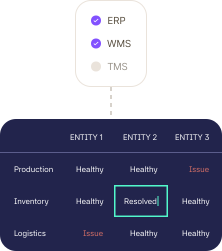
Live Operational Intelligence Across Critical Systems.
Continuously monitors ERP, MES, process control historians, and IoT systems in real time
Data flows continuously — not in scheduled batches — so signals are generated as events occur
Transactions, updates, and machine signals translated into a live operational picture
Coverage spans inventory, orders, production, logistics, and equipment performance
.svg)
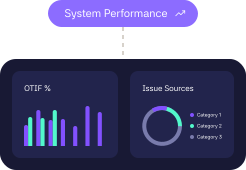
Impact-Based Routing That Cuts Through the Noise.
Signals prioritized by business impact — high-value issues surfaced first
Routed based on role and context — the right signal reaches the right person
A CEO sees what affects the business. A line manager sees what affects the line.
Less time triaging. More time acting on what actually matters.
Real-Time Intelligence That Doesn't Wait for Perfect.
Works with the data and systems that exist today — no perfect starting point required
Raw signals cleaned and structured to decision-grade quality before driving any alert
Combines real-time signals with existing batch pipelines for a complete operational picture
Data quality and coverage improve as the system expands and matures
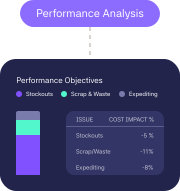
See What's Coming Before It Arrives.
Surfaces early warning signals before they materialize into operational problems
Predictive analytics for preventive maintenance, supply imbalances, demand shifts
Digital twin-ready — mirror assets, lines, or supply chain networks to model conditions and evaluate responses before acting
The business intervenes earlier — when options are still available and costs are lower
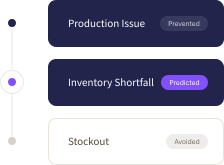
From Signal to Action. Without Waiting for Someone to Decide.
Microsoft Fabric Activator triggers automated workflows the moment a threshold is crossed
Rules and conditions defined upfront — so the system acts without human intervention
Alerts, notifications, and downstream actions triggered in real time
Automated response handles routine signals — freeing your team for higher-value decisions
Connected. Deployed. Integrated. From Signal to Action.
Define
We align on the use case, identify the data sources and systems involved, and define the signal logic, prioritization rules, and success criteria — so every subsequent phase builds on a clear, agreed foundation.
Connect
We integrate ERP, MES, process control historians, and IoT systems into a continuous data flow on Microsoft Fabric — cleaning and structuring signals to trustworthy without waiting for perfect data.
Deploy
We build and activate the signal logic, prioritization rules, thresholds, and Activator workflows — so the right signals reach the right people and automated responses trigger the moment conditions are met.
Integrate
We extend signals across teams and functions — ensuring upstream constraints surface downstream before they cause impact. Production sees supplier issues before they hit the line. Logistics sees production constraints before they affect fulfillment.
KINETIQ Watchtower establishes the real-time intelligence layer your operations have been missing.
What follows — automated workflows, agentic execution, and coordinated response across systems — builds on the signals and decision logic Watchtower puts in place.
We're not here to build a dashboard. We're here to change how your operations respond to what's happening.
Let's talk about where Watchtower fits in your operational intelligence strategy.
Try for yourself
The Hard Questions. Answered Honestly.
Read our FAQs:
What Is Watchtower, Really?
Dashboards and reporting tools show you what happened. KINETIQ Watchtower shows you what's happening — and what's about to. The difference is fundamental. Watchtower connects ERP, MES, process control historians, and IoT systems into a continuous flow of prioritized, decision-ready signals — routed to the right person or triggering automated response through Microsoft Fabric Activator before the window to act has closed. It's not a reporting layer. It's an operational intelligence system.
No — and it's not designed to. Watchtower complements your existing reporting and analytics layer by adding real-time signal detection, prioritization, and automated response on top of it. Your reports still tell you what happened. Watchtower tells you what's happening now — and acts on it before your next report is even generated.
De-Risking the Decision
Yes — and this is one of the most important design principles behind Watchtower. Real-time intelligence doesn't require perfect data. We meet your data where it is — across ERP, MES, process control historians, and IoT systems — and make it trustworthy before it drives any signal. Data quality and coverage improve as the system matures. You don't have to wait for a full data transformation to start seeing value.
Watchtower can start with the systems you have — ERP, WMS, and transactional data alone can generate meaningful real-time signals across inventory, orders, and logistics. MES, process control historians, and IoT data add depth and precision, particularly for predictive use cases. We'll assess what's available and design the signal logic around what exists today, with a clear path to expand as your operational technology matures.
The Signal Model
Signal prioritization is based on business impact — high-value issues surface first, low-value noise is filtered out. Routing is based on role and context — a line manager sees equipment signals that affect their line, an operations director sees signals that affect service levels across the network, and a COO sees what affects the business at the aggregate level. We define the logic, thresholds, and routing rules collaboratively during the Define and Deploy phases — so nothing reaches the wrong person and nothing important gets buried.
Activator allows us to define rules and thresholds that trigger automated actions the moment a condition is met — without waiting for human intervention. That might mean automatically creating a work order when equipment performance degrades, alerting a supplier when inventory drops below a threshold, or triggering a workflow when a production constraint is detected. The rules are defined upfront, tested before go-live, and refined over time as the system matures.
Predictive Intelligence
Watchtower continuously monitors equipment signals from MES, process control historians, and IoT sensors — identifying patterns that indicate degradation or emerging failure before it occurs. When those patterns cross defined thresholds, Activator triggers automated response — a maintenance alert, a work order, or a workflow — before the equipment fails and before production is impacted. The transition from reactive to predictive maintenance is one of the highest-ROI use cases Watchtower supports.
Signal accuracy improves over time as the system learns from operational patterns. We start with clearly defined thresholds and rules — validated against historical data during the Deploy phase — before going live. False positives are managed through the prioritization layer, and the routing model ensures low-confidence signals are handled appropriately rather than flooding teams with noise. The goal is actionable intelligence, not maximum alert volume.
Fit and Flexibility
Yes — and multi-site visibility is one of the most valuable use cases. Watchtower aggregates signals across facilities, giving operations leadership a unified view of what's happening across the network while ensuring site-level teams see only what's relevant to their operations. Cross-site constraints — a production issue at one facility affecting fulfillment at another — are surfaced before they cascade.
Watchtower doesn't replace existing alerting tools — it provides a layer of intelligence on top of them. Where existing tools generate raw alerts, Watchtower adds prioritization, context, and routing — so the right signal reaches the right person rather than everyone getting everything. For use cases where Activator can automate the response entirely, human notification may not be needed at all.
The Ongoing Relationship
Watchtower is designed to expand. Once the initial use case is live and validated, the signal logic, routing rules, and Activator workflows can be extended to additional systems, teams, and use cases — from additional facilities to new operational domains. For organizations ready to move from real-time intelligence to agentic execution, KINETIQ Orchestrate is the natural next step — building automated workflows and system-driven decisioning on top of the signal layer Watchtower establishes.
Ongoing support is available through KINETIQ Operate — our managed services offering that maintains system reliability, resolves issues, and delivers incremental improvements over time. For organizations that want a more active partner driving the roadmap and expanding capabilities continuously, KINETIQ Vanguard provides an embedded team accountable for outcomes across the broader intelligence and execution stack.
Why KINETIQ
Platform vendors know the technology. Generalist firms know consulting. KINETIQ knows supply chain and operational technology — and we've built Watchtower specifically around how manufacturing, CPG, and logistics operations actually generate, route, and act on signals. That domain depth is what makes the difference between a real-time intelligence system that reflects operational reality and one that reflects how a generic platform assumes operations should work.
Fabric's Real-Time Intelligence workload — including Activator — is purpose-built for exactly this use case. It handles continuous data ingestion from multiple sources, processes events as they occur rather than in batches, and triggers automated response natively without requiring additional integration layers. For supply chain and manufacturing operations, that means one platform for real-time signals, predictive intelligence, and automated workflows — without the complexity and cost of stitching together multiple tools.
Stop Reacting. Start Anticipating. Start Here.
Book a discovery call with our team