KINETIQ Foresight — Plan and Forecast Where Your Data Already Lives.
Most planning tools sit outside your data. Foresight doesn't. KINETIQ Foresight delivers S&OP and financial planning natively on Microsoft Fabric and D365 F&O — connecting operational data, financial targets, and planning workflows in a single environment, without the exports, reconciliations, and version conflicts that slow planning down.
Available as a D365 F&O implementation via Microsoft Business Performance Planning, or as a fully Fabric-native deployment.
Backed by deep supply chain and finance expertise, proprietary planning accelerators, and proven Fabric and BPP frameworks — so your planning model is accurate, governed, and grounded in how your business actually operates.



.png)

.png)


Your Plans Are Only as Good as the Data Behind Them.
Most Tools Make That Harder, Not Easier.
.svg)
By the Time the Plan Reaches the Team, the Data Has Already Moved.
Every planning cycle starts with a reconciliation exercise — pulling actuals from the ERP, refreshing exports, resolving version conflicts between what finance has and what operations is working from. The plan is stale before the meeting starts.
.svg)
S&OP and Financial Planning Run on Different Numbers.
When operational and financial plans live in separate systems, alignment requires meetings, not models. The gap between what operations expects and what finance plans for is where forecast accuracy breaks down — and where margin disappears.
.svg)
A Forecast That Can't See Today's Data Isn't a Forecast. It's a History Lesson.
If your planning tool can't see what's happening in your ERP and supply chain right now, it's projecting from yesterday. Every assumption drifts further from reality with each passing week — and by the time variances surface, the window to act has already closed.
Planning That's Connected to Your Operations — Not Struggling to Run Alongside Them.
Reactive planning manages variances.
KINETIQ Foresight helps prevent them — bringing S&OP and financial planning directly into your data environment, natively on Microsoft Fabric or D365 F&O via Business Performance Planning, so your plans reflect what's actually happening and alignment between operations and finance happens in the model, not the meeting.
.svg)
One Planning Environment. Connected to Every Number That Matters.
Foresight connects planning directly to your ERP, operational data, and actuals — so every plan starts from a single, trusted source. No disconnected systems. No conflicting numbers. No reconciliation between what the system shows and what the plan assumes.
.png)
S&OP and Financial Plans That Speak the Same Language.
Demand, supply, inventory, and revenue plans built on the same data foundation — so the volume your operations team commits to and the revenue your finance team plans for are derived from the same model, not reconciled after the fact.
.svg)
Forecasts That Update as Conditions Change — Not When Someone Remembers to Export.
Driver-based forecasting connected to near real-time ERP and operational data means variances surface as they develop — not at month-end close. Your planning team spends less time rebuilding the model and more time using it to make decisions.
Built for Planning That Shapes Reality.
Deep supply chain, finance, and Microsoft platform expertise. Proven Fabric and D365 F&O frameworks. Backed by proprietary planning accelerators, pre-built models, and native BPP delivery — built to connect every planning input to a single version of the truth, automatically.
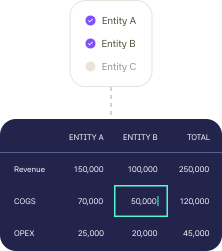
Your Plan Lives Where Your Data Lives.
No separate planning tool to feed, reconcile, or keep in sync with your ERP
Planning connects directly to the operational and financial data your business already runs on
Works with your existing Microsoft environment — whether you're on D365 F&O, Fabric, or multi-ERP
The plan starts from actuals, not from the last export someone remembered to run
.svg)
S&OP and Financial Planning in a Single Model.
Operational volume plans and financial targets built on the same data foundation
Demand, supply, inventory, and revenue plans connected — not siloed by function
Finance and operations work from one version of the plan, not two that need to be reconciled
Alignment happens in the model, not in the meeting
.svg)
Rolling Forecasts That Update From Live Data.
Forecasts connected directly to ERP transactions, operational signals, and actuals
Plans update continuously — so the forecast your team is working from reflects today, not last week
Variance between plan and actuals visible in real time, not at month-end close
Driver-based forecasting so the model responds to what's actually moving the business
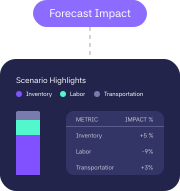
Scenario Planning at the Speed of the Business.
Model tariff impacts, demand shifts, supply disruptions, and capacity constraints before committing
Multiple scenario versions maintained simultaneously — compare outcomes side by side
What-if analysis runs against live data, not a static snapshot
Decisions made with current numbers, not last quarter's assumptions
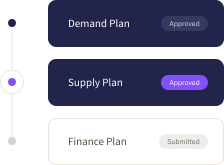
Governed Plans. Auditable. Without Spreadsheet Chaos.
Controlled planning workflows with role-based access and approval routing
Full version history — every plan change tracked, every assumption documented
Governance applied to planning data, not just reporting data
Excel remains available for input and review — governed, versioned, and connected to the plan rather than running parallel to it
From Disconnected Spreadsheets to a Living Plan. In Weeks, Not Quarters.
Define
We align on planning scope, use cases, and model architecture — identifying the data sources, planning dimensions, and forecasting drivers that will govern everything built in subsequent phases.
Connect
We integrate ERP, Fabric data, and operational systems into the planning environment — establishing the data flows, actuals feeds, and dimensional structures that make the plan trustworthy from day one.
Build
We configure S&OP and financial planning models, forecasting logic, scenario frameworks, and approval workflows — tested against real data before any user touches the system.
Activate
We go live with governed planning workflows, user training, and adoption support — and establish the cadence for rolling forecast updates, scenario reviews, and continuous model improvement.
KINETIQ Foresight establishes the planning infrastructure your operations, SCM, and finance teams have been missing.
What follows — rolling forecasts, scenario modeling, and connected S&OP workflows — builds on the data foundation and planning logic Foresight puts in place.
We're not here to implement a planning tool.
We're here to change how your organization plans and decides.
Let's talk about where Foresight fits in your planning and forecasting strategy.
Try for yourself
The Hard Questions. Answered Honestly.
Read our FAQs:
What Is Foresight, Really?
Standalone planning tools are built to operate independently of your data platform — which means integration is always an afterthought, and data is always a reconciliation exercise. Foresight is built the other way around: planning lives inside your data environment, natively on Microsoft Fabric or D365 F&O, so the plan starts from actuals, not from an export. The result is a plan your operations team trusts and your finance team can stand behind — without the middleware, the manual refreshes, or the version management overhead.
It depends on what you have. For organizations running disconnected spreadsheets or legacy planning tools alongside Fabric or D365 F&O, Foresight is designed to replace that layer entirely with a governed, connected planning environment. For organizations already using best-of-breed tools that are deeply embedded in their workflow, Foresight can complement them — but the honest answer is: if your planning tool isn't connected to your ERP and data platform natively, you're carrying a reconciliation cost that compounds every planning cycle.
D365 F&O or Fabric-Native — Which Path Is Right for Us?
For D365 F&O clients, Foresight is delivered via Microsoft Business Performance Planning — a purpose-built EPM product that connects natively to your F&O data, supports Excel writeback, and provides a governed planning layer without leaving the Microsoft ecosystem. For organizations on Fabric without D365 F&O, Foresight is deployed as a fully Fabric-native planning solution — built on OneLake with Direct Lake connectivity to your operational and financial data. Both paths deliver the same core outcome: planning that lives where your data lives, without the integration overhead of a disconnected tool.
Both can apply — and in many cases the right answer is a combination. BPP handles the structured financial planning and budgeting layer that connects directly to F&O, while Fabric handles the broader operational data and S&OP dimensions. We'll assess your environment during the Define phase and recommend the architecture that gives you the most connected and lowest-maintenance planning environment long-term.
De-Risking the Decision
Yes — and this is one of the most common starting points. Foresight doesn't require perfect data to deliver value. During the Connect phase, we establish the data flows, actuals feeds, and dimensional structures that make the planning environment trustworthy — starting with what exists today and improving coverage as the model matures. A connected plan built on imperfect data is still more reliable than a disconnected plan built on a manual export.
Most planning transformations stall because they try to solve the data problem and the process problem and the tool problem simultaneously — and none of them get resolved cleanly. Foresight starts with a scoped use case, connects it to the data that already exists, and delivers a working planning model before expanding scope. You see value before you've committed to a full transformation.
The Planning Model
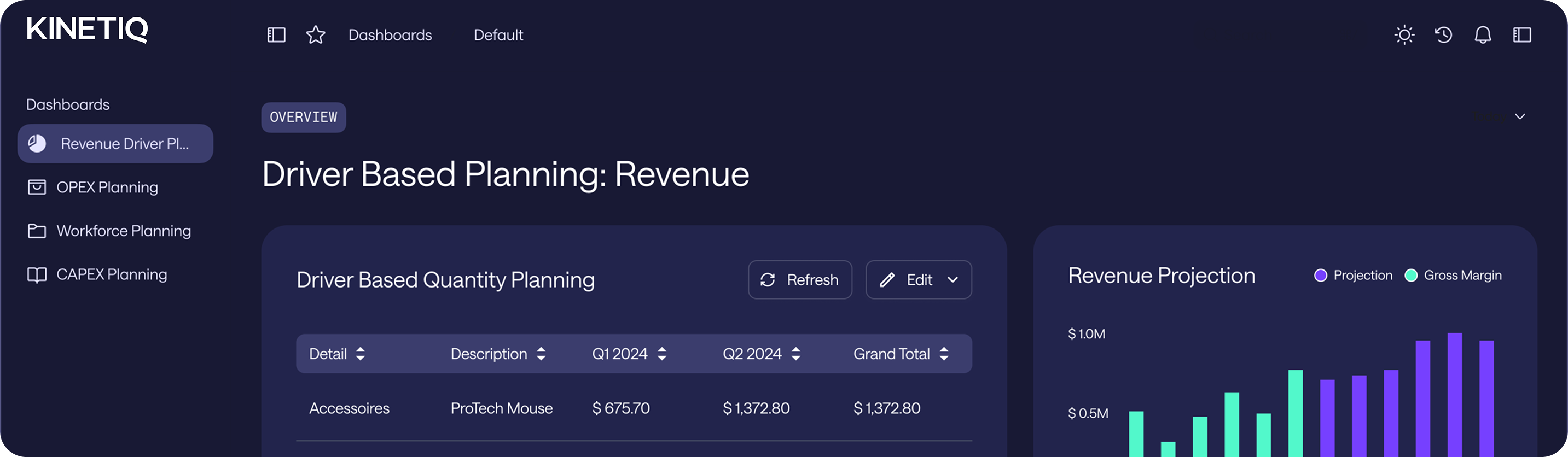
Driver-based forecasting replaces static assumptions with live operational inputs — so instead of manually updating a revenue forecast when volume changes, the model updates automatically because volume is a connected input. The drivers and business logic are defined collaboratively during the Build phase and validated against historical patterns before the system goes live. The result is a forecast that moves with the business, not one that has to be rebuilt every cycle.
Multiple scenario versions are maintained simultaneously — base case, upside, downside, and any specific scenarios relevant to your business, such as tariff impacts, supply disruptions, or demand shifts. Scenarios run against live data, not static snapshots, so comparisons reflect current conditions. Approval workflows can be applied per scenario, and version history tracks every assumption change across the planning cycle.
Fit and Flexibility
Yes — and cross-entity planning is one of the strongest use cases for both the BPP and Fabric-native paths. Foresight supports consolidated planning views across business units, with entity-level detail maintained underneath. Finance sees the consolidated picture. Business unit leads see their own plan. The reconciliation between the two is handled by the model, not by a spreadsheet.
Foresight is designed to be the data and model layer that your S&OP process runs on — not a separate system that has to be reconciled with it. Demand plans, supply constraints, inventory positions, and financial targets are maintained in the same environment, so the S&OP review is a decision meeting, not a data alignment exercise. The cadence and workflow of your S&OP process is configured during the Build and Activate phases.
The Ongoing Relationship
Foresight is designed to expand. Once the initial planning model is live and validated, the scope can extend to additional planning dimensions, business units, or use cases — from rolling forecasts to long-range planning to integrated scenario modeling. For organizations ready to move beyond connected planning to automated execution, KINETIQ Orchestrate is the natural next step — taking the decisions the planning model surfaces and triggering coordinated action across systems, without waiting for manual intervention.
Ongoing support is available through KINETIQ Operate — our managed services offering that maintains model reliability, resolves issues, and delivers incremental improvements over time. For organizations that want a more active partner driving the planning roadmap and expanding model capabilities continuously, KINETIQ Vanguard provides an embedded team accountable for outcomes across the broader intelligence and planning stack.
Why KINETIQ
KINETIQ is the deepest planning specialist in the Microsoft ecosystem — and uniquely, we work directly with Microsoft's product teams on the delivery of Business Performance Planning and Fabric-native planning solutions. That means our clients aren't just getting a certified implementation partner — they're getting a team that is actively shaping how these products are built and deployed. Combined with deep supply chain and financial operations domain expertise, that's the difference between a planning model that reflects how your business actually operates and one that reflects how a generic implementation assumes it should.
Because the data problem and the planning problem are solved in the same place. Fabric's OneLake gives you a single data foundation that eliminates the integration overhead of connecting a separate planning tool to your ERP and operational systems. BPP extends that into a purpose-built EPM layer with native F&O connectivity, Excel writeback, and governed planning workflows — without requiring a separate platform investment. For organizations already on the Microsoft stack, it's the lowest-friction, highest-integration path to connected planning.
Stop Planning Around Your Data. Start Planning With It.
Book a discovery call with our team