KINETIQ Vector — Turn Your Data Into Decisions. Not More Dashboards.
Your operation generates more data than ever — and most of it goes nowhere. Transactions, signals, and operational history accumulate across systems, but without the right models to extract signal from noise, data becomes a reporting exercise rather than a competitive advantage.
KINETIQ Vector changes that — scoped to a specific value leakage problem, built into a validated predictive model, and deployed as a productized ML workflow natively on Microsoft Fabric.
Backed by deep supply chain domain expertise and proven Fabric-native delivery — so the models we build reflect how your operations actually work, not how a generic data science engagement assumes they should.



.png)

.png)


You Have More Data Than Ever.
The Hard Part Is Knowing What to Do With It.
.svg)
More Data Doesn't Mean More Clarity. It Usually Means More Noise.
ERP transactions, supply chain events, operational history — the data exists, and there's more of it every year. But volume without the right models produces reports, not answers. The signal that could improve a forecast, prevent a failure, or protect a margin is in there. Most organizations just don't have the tools to find it.
.svg)
The Biggest Barrier to Data Science Isn't Capability. It's Knowing Where to Start.
Most operations leaders know that predictive modeling could help — but scoping the right problem, identifying the right data, and connecting it to a business outcome that justifies the investment is where most initiatives stall before they begin. The question isn't whether data science applies to your operation. It's where it will move the needle most.
.svg)
Gut Feel Is Not a Forecasting Model. And Spreadsheets Are Not a Substitute for One.
When the models don't exist, decisions default to experience and instinct — which works until it doesn't. Demand gets overforecast. Maintenance gets scheduled too late. Inventory gets positioned wrong. The cost of imprecise operational decisions compounds quietly across every planning cycle, every quarter, every year.
Your Data Already Contains the Answer.
Vector Finds It.
Vector doesn't start with a technique. It starts with a problem — a specific place in your operation where imprecision is costing margin, inflating cost, or leaving revenue on the table. From there, we build, validate, and deploy a productized predictive model natively on Microsoft Fabric, connected to the data and workflows your business already runs on.
.svg)
Scoped to the Problem That Moves the Needle Most.
Every Vector engagement starts with a defined value leakage problem — not a broad data science mandate. We identify where imprecision is costing you most, scope the model to address it, and build toward a measurable business outcome before a single line of code is written.
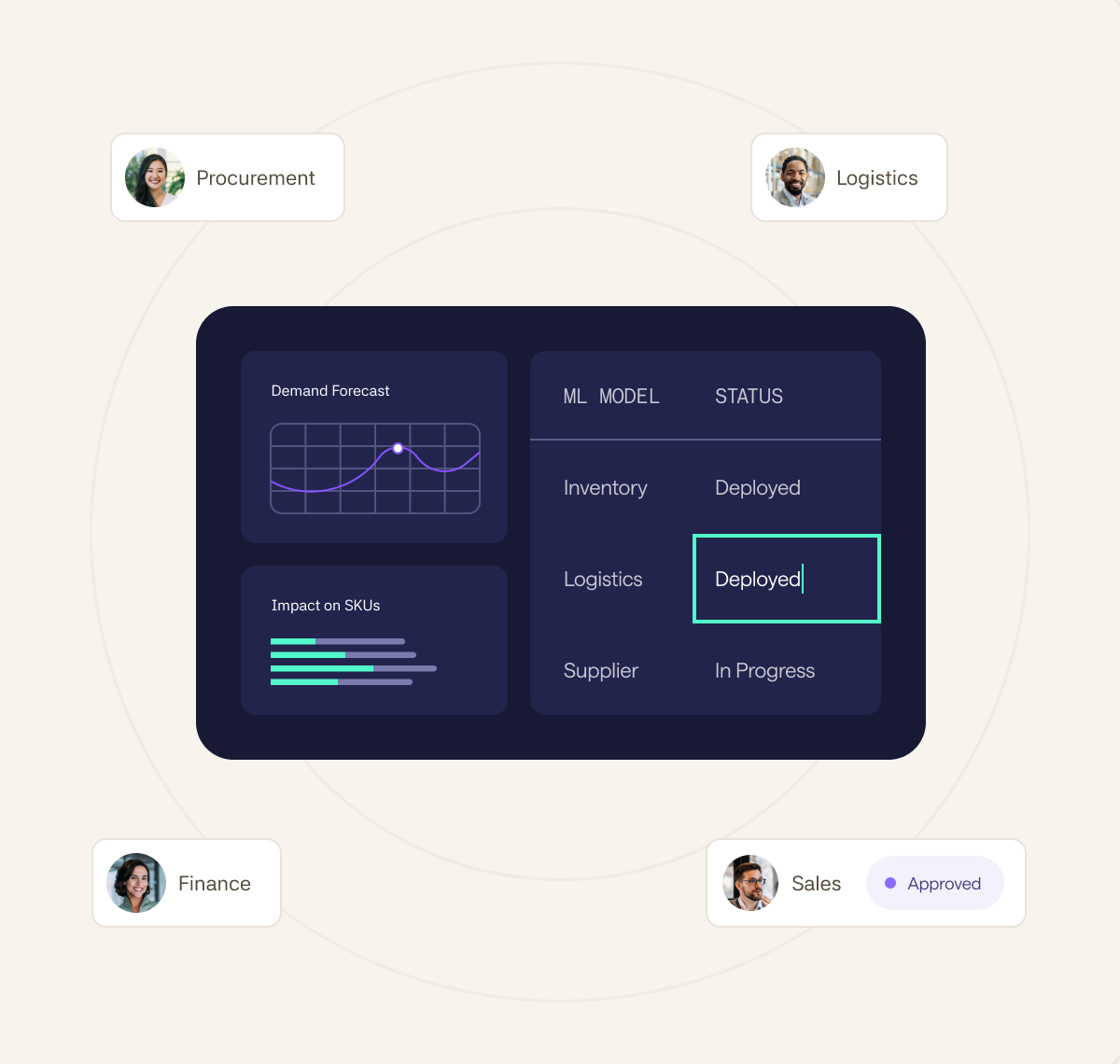
Built to Production. Not to a Prototype.
Most data science engagements produce a model that works in a notebook and never reaches the operation. Vector delivers a productized ML workflow — validated against your data, deployed natively on Microsoft Fabric, and connected to the decisions and systems it was built to improve.
.svg)
Domain Expertise That Generic Data Science Firms Can't Match.
A model is only as good as its understanding of the problem it's solving. KINETIQ brings supply chain and operational domain expertise to every Vector engagement — so the forecasting model accounts for seasonality and supplier lead times, the maintenance model understands equipment degradation patterns, and the output reflects operational reality rather than statistical abstraction.
The Right Model for the Right Problem.
Deployed Where It Matters.
Deep supply chain and operational domain expertise. Proven Fabric-native ML delivery. Backed by proprietary accelerators and pre-built model frameworks — built to extract signal from your operational data and deploy it where it drives decisions, not where it collects dust.
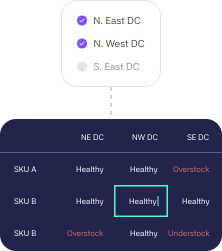
Your Demand Forecasts Are Costing You.
Overforecasting ties up working capital. Underforecasting loses revenue you can't recover.
SARIMA and ARIMA models account for seasonality, trend, and volatility that spreadsheet averages miss
MAPE improves as the model learns from your operational history
The result is a forecast your S&OP team can plan from, not one they have to second-guess
.svg)
Unplanned Downtime Has No Budget Line.
Equipment degrades in patterns statistical models can detect before the line goes down
Vector builds predictive maintenance models on MES, historian, and IoT data
Maintenance gets scheduled based on data, not just the calendar
Predictive maintenance delivers one of the highest ROIs of any data science application.
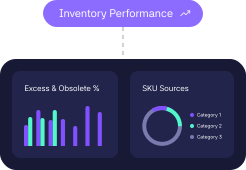
Excess Inventory Is Capital You're Not Using.
Most inventory problems stem from imprecise demand signals and one-size-fits-all stocking policies
Clustering models segment SKUs and locations by demand pattern, volatility, and margin — so stocking reflects actual behavior
Right-sized inventory means less capital tied up in slow stock and fewer stockouts on lines that matter
Deployed natively in Fabric on your ERP data
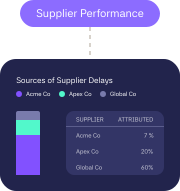
You Don't Know a Supplier Will Fail Until It Has.
OTIF variance, lead time drift, and order pattern changes all precede supplier failures that could have been anticipated
Vector builds supplier risk scoring models, ranking reliability and surfacing concentration risk early
High-risk suppliers get flagged in time to qualify alternatives, adjust safety stock, or renegotiate terms
The model runs continuously and updates as behavior changes, not just in annual review
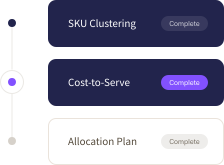
Not All SKUs and Customers Are Created Equal.
Uniform service levels treat your best customers and SKUs the same as your worst — and margin leaks quietly as a result.
Clustering models segment by behavior, profitability, and volatility — so allocation and service decisions are data-driven.
High-value segments get the attention they deserve. Low-value segments stop consuming resources they can't justify.
Segmentation models allow your commercial and operations teams can act together
The Value Was Always in the Data.
Vector Brings It to the Surface.
Discover
We identify the specific value leakage problem, confirm the data sources required to address it, and agree on the success criteria and business outcome the model will be held accountable to — before any modeling begins.
Develop
We assess, clean, and structure the data, establish feature engineering and historical depth, and build the initial predictive model — iterating against your operational data until the approach is sound.
Test
We validate the model against real operational conditions — stress-testing accuracy, refining against edge cases, and confirming it performs to the agreed success criteria before any production deployment.
Deploy
We productize the model as a native Fabric ML workflow — connected to the data pipelines, operational systems, and decision workflows it was built to improve, with monitoring in place to track performance over time.
KINETIQ Vector delivers what most data science engagements never reach — a validated, productized model running in your environment, solving a specific problem, and generating measurable return.
What follows — additional models, expanded use cases, and a maturing ML capability — builds on the foundation Vector puts in place.
We're not here to run a data science experiment. We're here to close the gap between the data your operation generates and the decisions it should be driving.
Let's talk about where Vector fits in your operational intelligence strategy.
Try for yourself
The Hard Questions. Answered Honestly.
Read our FAQs:
What Is Vector, Really?
Vector is a scoped data science engagement — we identify a specific value leakage problem in your operation, build and validate the predictive model that addresses it, and deploy it as a productized ML workflow natively on Microsoft Fabric. You don't walk away with a prototype or a recommendation deck. You walk away with a model running in your environment, connected to your data, and generating measurable operational impact.
Most data science teams build models. KINETIQ builds models that understand supply chain and operational context — which is what determines whether the output is actionable or just statistically interesting. An internal team may have the technical capability but rarely has the combination of domain expertise, Fabric-native delivery, and a proven engagement model that gets to production in months rather than years.
Where Does Vector Fit?
Vector always follows Blueprint and Foundation — because the data quality, structure, and accessibility that Foundation establishes is what makes a predictive model reliable. A model is only as good as the data it runs on. If that foundation isn't in place, we'll tell you before we scope a Vector engagement.
If your operation generates data but your decisions still rely heavily on experience, intuition, and spreadsheets — Vector is built for you. You don't need to know exactly where the margin is leaking or which problem to model first. That's what the Discover phase is for. We come in, map where imprecision is costing you most, and scope the engagement around the problem that will move the needle fastest. The only prerequisite is operational data — and if you've been running an ERP and supply chain for any length of time, you have more of it than you think.
De-Risking the Decision
During the Discover phase we map value leakage across your operation — looking for where imprecision is costing margin, inflating cost, or leaving revenue on the table. We prioritize based on data availability, business impact, and model feasibility. The engagement doesn't start until we've agreed on a problem that is specific, measurable, and worth solving.
Data quality is assessed during the Discover phase — and it's one of the most common starting points. If gaps exist, we address them before modeling begins. A model built on unreliable data will produce unreliable outputs, and we won't deploy one. If the data isn't ready, we'll tell you what needs to happen before Vector can deliver the outcome it's scoped to achieve.
The Model
The model is determined by the problem, not the other way around. For demand forecasting, we often use SARIMA, ARIMA, or more advanced time-series approaches. For predictive maintenance, regression and anomaly detection models on MES and historian data. For inventory optimization and customer segmentation, clustering models. The technique is always in service of the business outcome — never selected because it's the most sophisticated option available.
The Discover and Develop phases establish the foundation. By the Test phase — typically weeks 10 to 16 — the model is running against real operational data and producing outputs your team can evaluate. Full production deployment and measurable business impact follows from week 16 onward. For most engagements, clients see clear directional value well before the model reaches full deployment.
Fit and Flexibility
Yes — and most clients expand beyond the initial engagement once the first model is live and generating return. The Discover phase for a second engagement is faster because the data foundation is already in place and the team understands your operational context. Each additional model builds on the last, compounding the intelligence across your operation over time.
Yes — and this is one of the most overlooked aspects of data science engagements. Models drift as operational conditions change. KINETIQ Operate provides ongoing monitoring, retraining, and performance management to ensure the model continues to deliver the accuracy it was built to achieve. A deployed model that isn't maintained is a model that degrades quietly until it stops being trusted.
The Ongoing Relationship
Deployment is the beginning, not the end. Once the first model is live and validated, the natural next step is expanding — refining the initial model as operational conditions evolve, or scoping the next highest-value problem. For organizations that want a managed partner to monitor model performance, retrain as conditions change, and ensure the model continues to deliver the accuracy it was built to achieve, KINETIQ Operate provides exactly that — without the overhead of managing it internally.
For organizations ready to move beyond individual model engagements to a continuously evolving ML capability across their operation, KINETIQ Vanguard is the natural path. Vanguard embeds a dedicated KINETIQ team accountable for outcomes across your full intelligence and analytics stack — identifying new value leakage opportunities, expanding the model portfolio, and ensuring the return compounds over time rather than plateauing after the first deployment.
Why KINETIQ
Specialist analytics firms know the models. KINETIQ knows the models and the supply chain — and that domain depth is what separates a model that reflects operational reality from one that produces statistically valid outputs nobody acts on. Combined with Fabric-native delivery, a proven engagement model, and direct connectivity to the data your operation already runs on, Vector is built to reach production and stay there.
Because the data and the model live in the same place. Fabric's unified data layer means the model runs directly against your operational data without the integration overhead of connecting a separate ML platform to your ERP and supply chain systems. That reduces complexity, improves model accuracy, and shortens the path from development to production — which is where most data science investments stall.
The Margin You're Looking for Is Already in Your Data. Let's Find It.
Book a discovery call with our team