KINETIQ Launch: The Fastest Path to Proven ROI with Microsoft Fabric.
KINETIQ Launch takes one defined use case from data to a production-ready system on Microsoft Fabric, built for finance, supply chain, and operations teams who need to deliver value fast.


.png)

.png)


Most Implementations Lose Momentum Before They Even Begin.
The reason most implementations stall isn't the technology, it's the setup.
KINETIQ Launch starts with a defined use case, a validated business case, and a verified architecture already in place, so we build from day one instead of figuring out what to build.

Most Implementations Start From Scratch, and It Shows.
Without a validated use case, business case, and architecture already in place, teams spend the first several weeks figuring out what to build instead of building it. KINETIQ Launch starts with all three already defined, so day one is focused on delivery, not discovery.
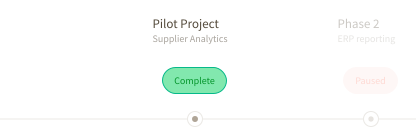
ROI Has to Be Measurable to Be Defensible.
Without a clear link to business value, new systems become easy targets when budgets tighten or priorities shift. A working pilot is not the same as a return on investment you can point to.

Speed to Value Is a Competitive Advantage.
The right implementation is designed from the start to go live, prove impact, and create momentum to expand, not stall after kickoff.
Designed to Prove Value from Day One.
KINETIQ Launch takes one defined use case and builds it into a production-ready system on Microsoft Fabric, scoped around a real business outcome and validated at every step.
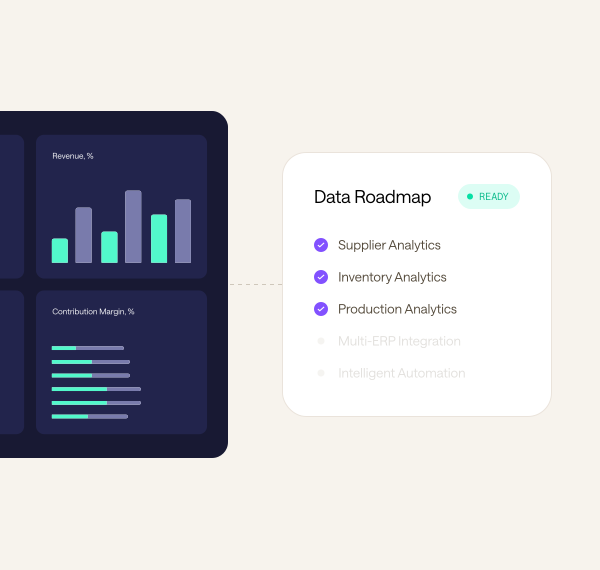
One Use Case. Fully Scoped. Delivered Into Production.
Launch is deliberately narrow by design. One use case, clearly scoped, with defined success criteria resulting in a working system in production that the business can leverage from day one.
- Focused use case and defined architecture
- Prove value quickly and establish foundations
.png)
Impact You Can Measure. Not a Demo You Can Show.
A compelling demo or pilot doesn't justify the next investment. A production system with measurable impact does. Every Launch engagement is scoped around a specific, quantifiable business outcome, so ROI is measurable, not theoretical.
- Defined ROI and quantified business outcomes
- Accelerated time-to-value

One Use Case Today. A Platform for Everything That Follows.
Launch is the starting point, not the destination. What we build is architected for extensibility, so the next use cases and capabilities build on the same foundations without rework or disruption.
- Extensible architecture and scalable foundations
- Reusable design patterns for additional use cases
Built to Prove Value. Designed to Scale.
Most implementations take months to show any value, and even longer to reach production. KINETIQ Launch is scoped to prove value fast, building a defined use case into a production-ready system on Microsoft Fabric with measurable business impact from day one. This serves as the foundation for expanding scope and scaling Fabric across your organization.
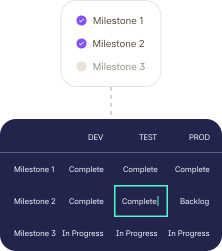
Starts With a Defined, Actionable Blueprint
Use case, ROI, and architecture are already defined before a line of code is written
No re-scoping, no realignment — day one is focused on building
Blueprint's validated foundation becomes Launch's starting point
No time lost figuring out where to begin
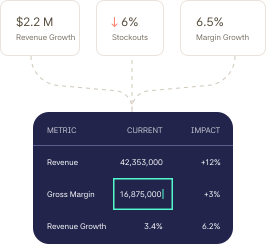
A Production System the Business Can Operate on Immediately.
Deployed directly into your Microsoft Fabric environment — not a sandbox
Built to handle real data, real users, and real operational complexity
Every output validated against the original use case before go-live
Operable, measurable, and expandable from day one
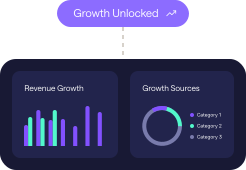
Measurable Impact. Not a Compelling Demo.
Scoped around a specific, quantifiable business outcome from the start
Success criteria defined upfront — revenue, cost, margin, or working capital
Impact measured against the baseline established in Blueprint
If it can't be tied to a measurable outcome, it doesn't belong in scope
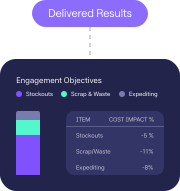
Fixed Scope. Fixed Investment. Clear Outcomes.
One use case with clearly defined boundaries, deliverables, and success criteria
Fixed investment aligned to a defined outcome — no open-ended billing
Every milestone visible, agreed upon, and validated throughout delivery
No surprises — the business knows what it's getting, what it costs, and when
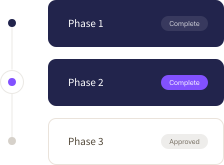
Architecture That Scales Beyond the First Use Case.
Data models, pipelines, and architecture built for extensibility from day one
No rework required when the next use case is ready to build
Designed to support real-time intelligence, automation, and agentic workflows
What gets built in Launch doesn't just prove value — it compounds it
From Blueprint to Production.
In 13 Weeks.
Kickoff & Alignment
We pick up Blueprint's validated outputs — use case, ROI case, and target architecture — and align on data access, success criteria, and delivery priorities. The build starts with everything already defined.
Build
We develop the data models, pipelines, and workflows on Microsoft Fabric — building directly against the use case and success criteria defined in Blueprint, with continuous validation throughout.
Deploy & Validate
We push the system into production and validate it against Blueprint's original ROI case. Real data. Real users. Real operational complexity. The system is live and measurable impact is confirmed.
Scale
The use case is live and the value is proven. Expanding from here — into additional use cases, capabilities, and workflows — requires a longer-term partnership commitment. This is where the real compounding begins.
KINETIQ Launch is the proving ground designed to lay the groundwork.
What follows is joint-development of your roadmap. KINETIQ is your partner in navigating expanding use cases, real-time intelligence, and automation, wherever your data and AI journey leads.
Let's talk about where Launch fits into that roadmap.
See Our Work in Action
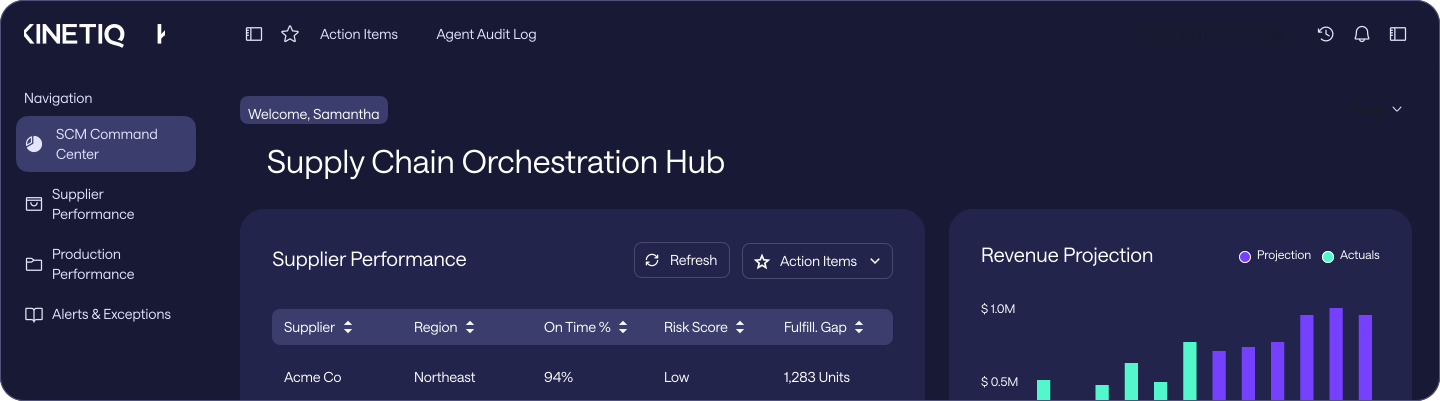
The Hard Questions. Answered Honestly.
Read our FAQs:
What Is Launch, Really?
Most pilot engagements are scoped to demonstrate potential — they're designed to impress, not to operate. KINETIQ Launch is different in three fundamental ways: it starts from Blueprint's validated foundation rather than assumptions, it's built for production from day one rather than adapted for it later, and success is defined by measurable business impact rather than a compelling demo. The result is a pilot that was always designed to survive contact with the business.
Blueprint is a prerequisite for Launch — and intentionally so. Blueprint defines the use case, quantifies the ROI, and designs the target architecture before any building begins. Launch picks up exactly where Blueprint ends. Without that foundation, Launch would be just another pilot starting from assumptions. With it, day one is focused on building, not figuring out what to build.
De-Risking the Decision
The reason most pilots don't make it to production isn't the technology — it's the setup. They start without a defined use case, a quantified business case, or a production-ready architecture. Launch eliminates all three gaps before the first line of code is written. Blueprint defines the problem, proves the ROI, and designs the architecture. Launch builds it — end to end, into production, with validated outputs at every step.
Impact and requirements are defined, scoped, and agreed upon before delivery begins — tied directly to Blueprint's ROI case. We don't move into delivery without clear success criteria. If something isn't tracking against those criteria during delivery, we address it in real time. The continuous validation built into our delivery model means there are no surprises at the end — only a system that performs against what was promised.
Scope and Commitment
Launch is deliberately narrow — one use case, clearly defined boundaries, and a fixed scope. That narrowness is a feature, not a limitation. It's what makes production in 13 weeks achievable and what keeps the business case defensible. Scope changes mid-delivery introduce the same risks that sink most pilots. If additional use cases surface during Launch, we capture them for what comes next — they don't get folded into the current engagement.
Launch requires active engagement from your team — particularly in the Kickoff & Alignment phase. We need confirmed access to your data systems, a dedicated point of contact, and key stakeholders available for validation at each phase. Blueprint will have already done the heavy lifting on alignment — so the commitment during Launch is focused, not open-ended. The more engaged your team is early, the cleaner the delivery.
The Deliverables
A production-ready system deployed in your Microsoft Fabric environment — built around the use case Blueprint defined, validated against the ROI Blueprint quantified, and ready for your team to operate on from day one. That includes the data models, pipelines, operational workflows, and reporting layer the use case requires. Not a prototype. Not a proof of concept. A working system the business can use immediately.
Usability is built into the delivery model, not bolted on at the end. We validate outputs with your team throughout delivery — not just at the finish line. The system is built around how your team actually works, with the operational context, decision logic, and workflows they need to act on what it surfaces. A technically functional system that nobody uses isn't a success. We don't ship until it's both.
Fit and Flexibility
Blueprint is a prerequisite — and for good reason. Starting Launch without Blueprint means starting without a defined use case, a quantified ROI, or a validated architecture. That's exactly the setup that causes most pilots to fail. If you don't have Blueprint yet, that's the right place to start. It's a 6-8 week engagement that gives Launch everything it needs to succeed.
Launch is built on Microsoft Fabric — and we use OneLake Shortcuts and Mirroring to connect your existing systems without forcing a rip-and-replace. Your ERP, WMS, TMS, and other data sources stay where they are. We bring them into Fabric for the use case at hand, without disrupting what's already running. No rip-and-replace. No operational disruption.
What Comes After Launch
Launch ends with a working system, validated impact, and a clear view of what comes next. Expanding beyond the first use case — into additional workflows, real-time intelligence, and agentic execution — requires a longer-term partnership commitment. We'll present the results, align on what the data tells us about where to go next, and transition into that partnership. We're not here to deliver a pilot and move on.
It depends on where you want to go. For organizations ready to scale across the data estate, KINETIQ Foundation or Vanguard is typically the right next step. For those who want to expand specific capabilities — real-time intelligence, orchestration, or ongoing optimization — Watchtower, Orchestrate, or Operate may be the better fit. What we don't do is a series of one-off engagements. The relationship that follows Launch is structured, committed, and designed to compound the value of what Launch proves.
Why KINETIQ
Most firms can run a pilot. Few can deliver a production system in 13 weeks on a narrowly scoped use case, starting from a validated foundation, with measurable impact built into the definition of success. We bring deep supply chain domain expertise, proprietary delivery frameworks, pre-built Fabric IP, and a delivery model built around production — not demonstration. We've done this before, in this industry, on this platform. That's not a marketing claim. It's why Blueprint graduates choose us to build what they've already validated.
Fabric is where data, analytics, and operational intelligence converge in a single environment — without the complexity and cost of maintaining multiple platforms. For supply chain specifically, that means one place to bring in your ERP, WMS, and TMS data, one place to build the models and workflows the use case requires, and one platform that scales as the use case expands. The first production win on Fabric becomes the foundation every subsequent one builds on — without rework or disruption.
The First Production Win Changes Everything That Follows.
Book a discovery call with our team