KINETIQ Orchestrate: Agentic Workflows for Finance & Operations
KINETIQ Orchestrate brings agentic workflows into your finance and operations processes, engineered to strike the right balance of autonomy and governance. Agents work alongside your team, with humans in the loop wherever judgment is required.



.png)

.png)


Data Travels Fast. Decisions Take Days.
.svg)
The Decision Should Take Seconds. It's Taking Days.
Every time a routine problem in finance, operations, or supply chain reaches your best people, the response that should happen in minutes takes days. That delay has a real cost, and it compounds the whole time the business waits.
.svg)
Same Data. Different Teams. Different Answers.
When decisions get made across finance, operations, and supply chain using different assumptions and priorities, execution fragments. The same event triggers different responses in different parts of the business, creating inconsistency, conflict, and avoidable cost.
.svg)
Tradeoffs Made in Silos Cost the Business Twice.
A decision that looks right for one function often creates a problem for another. Without shared visibility into cost, service, and financial impact, finance, operations, and supply chain make tradeoffs in isolation, and the business absorbs the difference in higher costs, missed targets, and wasted resources.
Stop Losing Margin to Decisions That Arrive Too Late and Too Inconsistently.
Fragmented decisions cost organizations revenue, margin, and the time your best people spend resolving problems that should be routine.
KINETIQ Orchestrate closes that gap. It connects the context across functions and routes it to the right people the moment it matters, automating the repeatable tasks and keeping your team in the loop for everything that needs human judgement and expertise.
.svg)
Automated Where It Should Be. Human Where It Matters.
KINETIQ Orchestrate automates repeatable operational decisions within the guardrails and rules you define, and routes to your team when a decision needs judgment, approval, or expertise. Your best people stay focused on the work that actually needs them.
.png)
Systematizing Decisions Across Every Function.
KINETIQ Orchestrate connects finance, operations, supply chain, and other functions to the same data and context, so every team sees the same event the same way. We build the workflows, approvals, and automations that turn that shared context into coordinated action, wherever the disruption first surfaces.
.svg)
Decisions That See the Whole Business, Not Just One Part of It.
A decision that looks right for one function often creates a problem for another. KINETIQ Orchestrate gives finance, operations, and supply chain shared visibility into cost, service, and capacity impact, so decisions get made with the full picture instead of just the view from one team's desk.
Reimagine Your Processes With Data, Context, and Automation.
We connect your systems into one operational and financial picture, then build the automated workflows to route context to the right people and close the loop between data, decisions, and action.

One Shared Context Across Systems
Finance, operations, supply chain, and HR data connected into one model
Every decision made against the same context, not isolated data
Cross-functional workflows and analytics built on one shared foundation
Decisions reflect actual business context, not function-level assumptions
.svg)
Ask Your Data Anything
Use AI to query your data in natural language
No query, report, or dashboard required
Answers across finance, operations, and supply chain
Faster time from question to answer
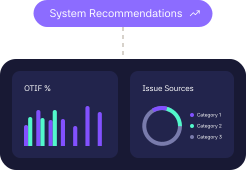
Exceptions Routed With Context, Not Just Alerts.
Variances detected and translated into business impact
The right people in the right functions notified automatically
Context included, not just a flag or a ticket
Faster, more coordinated response to every exception
Narrow Tasks, Fully Agentic.
Clearly defined, high-volume tasks handled end-to-end by AI agents
Examples: PO and invoice reconciliation, freight audit, change order audit
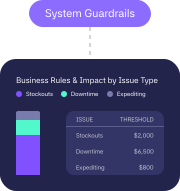
Agentic automation scoped with defined rules and guardrails
Exceptions caught and resolved before they impact business performance
Autonomy You Control. Guardrails You Define.
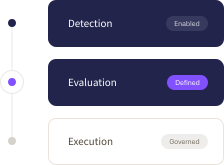
You decide where automation runs and where humans stay in the loop
Every action is auditable and traceable back to its source
Rules and thresholds set by your team, not a black box
Governance and structured autonomy built into every workflow
Your Orchestrate Solution.
Defined. Built. Integrated.
Define
We align on the use cases, identify the data sources and systems involved, and define the workflows, guardrails, and success criteria, so every later phase builds on a clear, agreed foundation.
Build
We connect your data and build the analytics, workflows, and automation on Microsoft Fabric, Copilot, & Power Platform, configuring the logic and guardrails for each use case.
Deploy
We activate the workflows in production, validating them against real operational data, calibrating where automation runs and where your team stays in the loop, and confirming everything works within the guardrails you defined before expanding scope.
Integrate
We extend what's built across teams and functions, so the same context and workflows reach every part of the business they affect, from finance and procurement to operations and production.
The gap between knowing and acting is where margin is lost.
KINETIQ Orchestrate closes it. We connect the context across functions, automate repeatable workflows, and route critical exceptions to your team with the information they need to decide quickly.
Start with one high-value use case. Prove the value. Then expand.
Let's talk about what that looks like for your business.
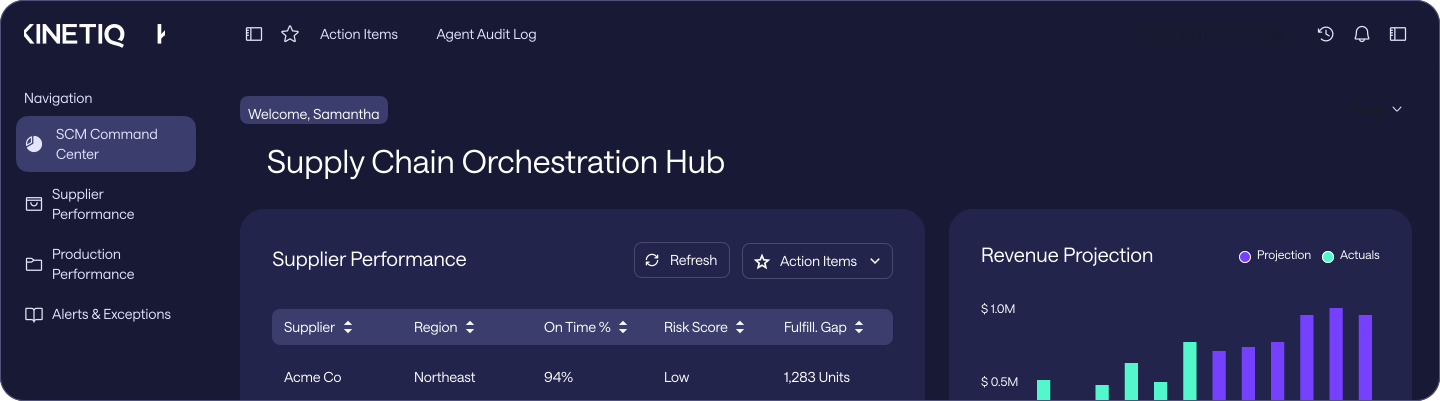
Try for yourself
The Hard Questions. Answered Honestly.
Read our FAQs:
What Is Orchestrate, Really?
Workflow automation and RPA follow predefined rules. KINETIQ Orchestrate evaluates tradeoffs — continuously weighing cost, service, capacity, and working capital against defined business priorities before determining and executing the optimal action. The difference is fundamental: automation executes instructions, Orchestrate makes decisions. When conditions change, rules break. When conditions change, Orchestrate adapts.
It's both — and that's what makes it different. Orchestrate evaluates decisions against forward-looking targets, constraints, and policies, then executes through agents, workflows, and integrations. It's not a planning system that produces a plan for humans to act on. It's a decision engine that evaluates and acts — with humans engaged exactly where governance rules require it.
De-Risking the Decision
Orchestrate is deployed as a production system from day one — not a proof of concept designed to impress in a controlled environment. Every decision loop is tied to a defined financial outcome before work begins. We start with the highest-value use case, validate decisions against real operational data, and expand based on proven results. The governance model ensures the system never acts outside defined boundaries — so confidence grows incrementally, not all at once.
Every decision is auditable — with full visibility into what was decided, why, and what happened. Autonomy thresholds and guardrails are defined upfront, so the system only acts automatically within boundaries the business has explicitly set. For decisions that fall outside those boundaries, the system routes to human operators. Incorrect decisions are caught, reviewed, and used to refine the decision logic — making the system more accurate over time.
Governance and Control
Complete control — and this is a core design principle of Orchestrate. Clients define the decision logic, thresholds, and guardrails upfront. They decide where the system acts automatically and where human approval is required. Every action is fully auditable. Autonomy is earned incrementally — starting with clearly defined use cases and expanding only as the system proves value. The system never acts outside the boundaries the business has set.
Every decision the system makes is logged with full context — what signal triggered it, what tradeoffs were evaluated, what action was taken, and what the outcome was. This auditability is built into the architecture from day one, not added as an afterthought. Operations teams have complete visibility into every decision the system has made — so trust is built through transparency, not assumption.
The Execution Model
Orchestrate executes through three models — direct integration into source systems via defined interfaces, push to system of execution where the downstream system handles the action, or human-in-loop routing where the decision is presented for approval before execution. The right model for each decision type is determined by the client's existing stack, governance rules, and what's most cost-effective. Most engagements use a blend of all three.
No — and it's not designed to. Orchestrate works alongside your existing systems — ERP, WMS, TMS, and others — connecting them into a coordinated decision and execution layer without replacing them. It doesn't require a rip-and-replace. It requires decision-grade data, clearly defined use cases, and the governance framework to operate within. Your existing systems remain the systems of record. Orchestrate is the layer that ensures they act in concert.
Fit and Flexibility
Orchestrate is designed for high-frequency, high-impact operational decisions where speed and consistency matter — inventory rebalancing, supply disruption response, production resequencing, demand-supply alignment, and logistics optimization. These are decisions that happen constantly, involve competing tradeoffs across functions, and currently consume significant time from your best operators. They're also the decisions where even small improvements in speed and consistency translate directly into margin.
Not necessarily — Orchestrate requires decision-grade data and real-time operational signals, which Watchtower provides natively. If you already have reliable real-time data feeds from your operational systems, Orchestrate can be deployed without Watchtower. We assess your data maturity upfront and determine the right starting point. Where the data foundation isn't decision-grade, we'll be transparent about what needs to be established first.
The Ongoing Relationship
KINETIQ Orchestrate is a defined engagement — we scope, build, and integrate a specific set of decision agents tied to agreed use cases and outcomes. Once delivered, organizations that want to continuously evolve their decision intelligence — adding new agents, expanding use cases, and scaling execution across the business — typically move into KINETIQ Vanguard, our embedded partnership model. For organizations with more targeted needs, a new defined engagement can be scoped to extend capabilities further.
System reliability and maintenance for the deployed agents is available through KINETIQ Operate — keeping pipelines, workflows, and decision logic performing as the business evolves. For organizations ready to go further — building new agents, expanding decision loops, and driving continuous execution — KINETIQ Vanguard provides the embedded team and sustained commitment that takes Orchestrate from a defined deployment to an ongoing competitive advantage.
Why KINETIQ
Platform vendors provide the technology. KINETIQ provides the decision intelligence built on top of it — proprietary accelerators, pre-built decision logic, and deep supply chain expertise that reflects how manufacturing, CPG, and logistics operations actually make and execute decisions. We don't deploy a generic platform and hand it off. We build a governed decision engine grounded in your operations, deployed against your highest-value use cases, and accountable for the outcomes it delivers.
Fabric IQ provides the unified foundation that agentic decision execution requires — real-time data ingestion, governed data agents, workflow orchestration, and the ability to act across systems in a single environment. For supply chain operations, that means one platform for signals, decisioning, and execution — without the complexity and cost of stitching together multiple tools. It's also the platform Microsoft is investing most aggressively in for agentic AI — which means the capabilities we deploy today will compound in value as the platform evolves.
The Gap Between Data and Decisions Closes Here.
Book a discovery call with our team